
Use EveryFeed with Codex
Add the EveryFeed MCP server to Codex and manage social content from a task.
Codex in your terminal runs the EveryFeed CLI through the skill; Codex on the web connects over MCP instead. Either way, once connected you do not need to call the tools yourself: describe what you want in a Codex task. (Not sure which connection fits your setup? See which connection do I need.)
Connect Codex
In EveryFeed, open Settings → Developers → Access and find the CLI & AI Skills card. Pick Codex — it shows the same three steps as below.
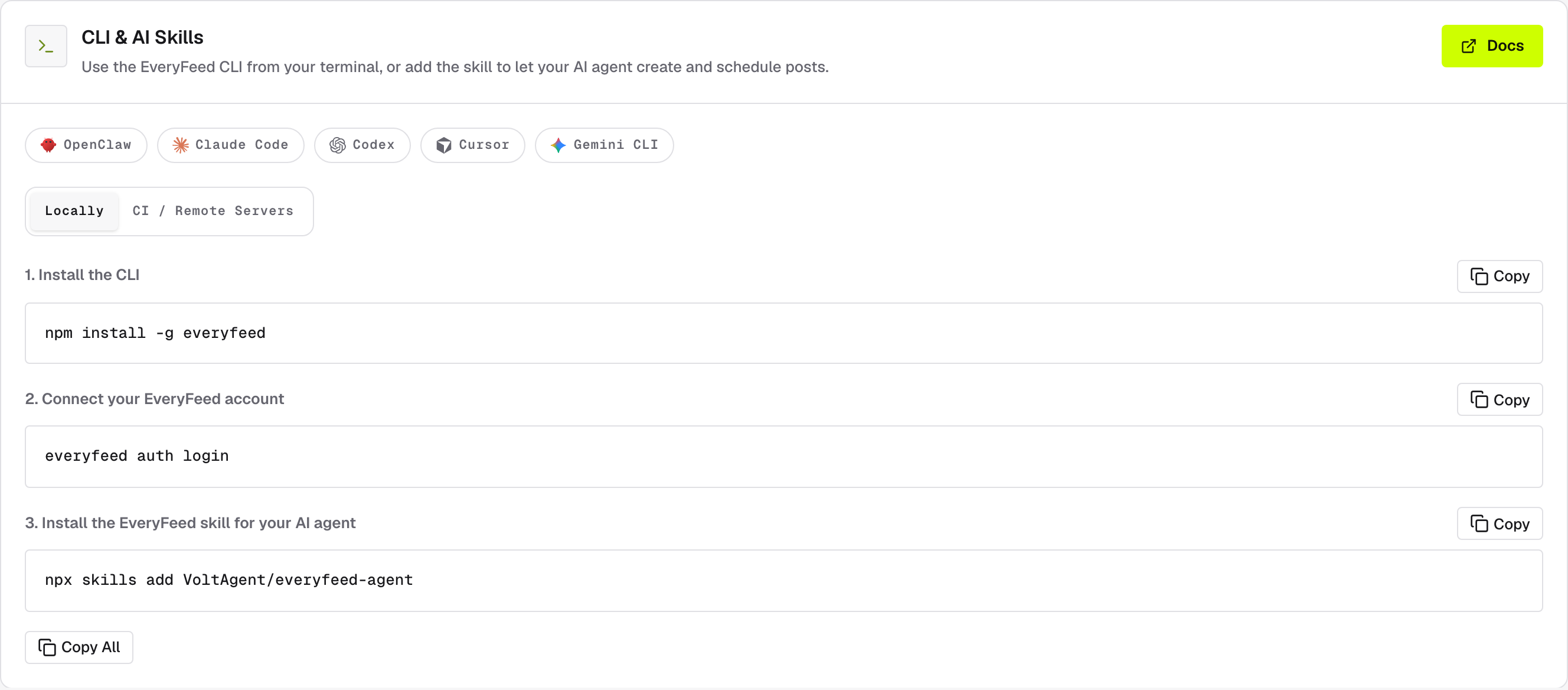
Install the CLI — the tool that talks to EveryFeed from your terminal:
npm install -g everyfeedConnect your EveryFeed account — this opens EveryFeed in your browser; sign in, choose the organization, and approve the device shown in your terminal:
everyfeed auth loginInstall the EveryFeed skill for Codex — a separate piece: the playbook that teaches Codex when and how to use that CLI:
npx skills add VoltAgent/everyfeed-agentStart a new task and ask Codex to list your EveryFeed channels. If the tools are unavailable, check the configuration and restart Codex again.
Alternative: connect over MCP
A separate option, not part of the flow above — use it if you'd rather not
install the CLI. Under MCP Client Configuration, switch to
API Key (Manual), pick Codex, and paste the generated
[mcp_servers.everyfeed] block at the end of ~/.codex/config.toml (replace
the section if it already exists):
[mcp_servers.everyfeed]
url = "https://api.everyfeed.ai/mcp"
http_headers = { Authorization = "Bearer YOUR_EVERYFEED_TOKEN" }
Verify with codex mcp list. For Codex on the web, OAuth (Recommended)
also works: copy the MCP server URL, add it as a connector, and approve
access — no key required.
Can't send an Authorization header at all (some CI systems and hosted
runners)? The CI / Remote Servers block of the same card offers a
key-in-URL endpoint (…/mcp/<key>) — the key is part of the URL, so treat
the whole URL as a secret.
Running in CI or on a remote server
No browser on the machine? The CI / Remote Servers tab of the CLI & AI Skills card
shows the same three steps with one swap: instead of everyfeed auth login,
authenticate with your workspace API key as an environment variable:
export EVERYFEED_API_TOKEN="YOUR_EVERYFEED_TOKEN"What to ask
List my connected channels in EveryFeed.Prepare a LinkedIn launch post in EveryFeed. Do not publish it yet.Adapt this copy for LinkedIn and X, then validate both drafts: [paste copy]Schedule the approved post for tomorrow at 10:00 in Europe/Istanbul.Show me the status of my recent EveryFeed posts.Generate an image for this post in EveryFeed and attach it: [describe the image].Import this image or MP4 into EveryFeed from a URL and attach it: [paste URL].Generate a short video in EveryFeed for this post, then attach it once ready.Turn this into a 3-post thread for X in EveryFeed, then validate it.Find the next available slot and schedule the approved post there.For a client-specific request, include the client group name. For scheduling, include an exact date, time, and time zone whenever possible. AI image and video generation run only after you confirm and use your organization's AI allowance; video is prepared in the background and attached when it is ready.
Review and approval
Codex resolves the connected channels, checks each provider's rules, and validates the draft. Before creating an immediate or scheduled post, it shows the destination channels, copy, media, publishing mode, exact time and time zone, and short-link behavior.
Nothing is created until you explicitly approve that exact review. If anything changes, Codex validates the new version and asks for a fresh approval.
Keep access tokens out of chat
Store the credential only in the generated Codex configuration. Never paste it into a Codex conversation. If the key appears in a screenshot, message, log, or public file, rotate it in Settings → Developers → Access — rotation invalidates the old key immediately.